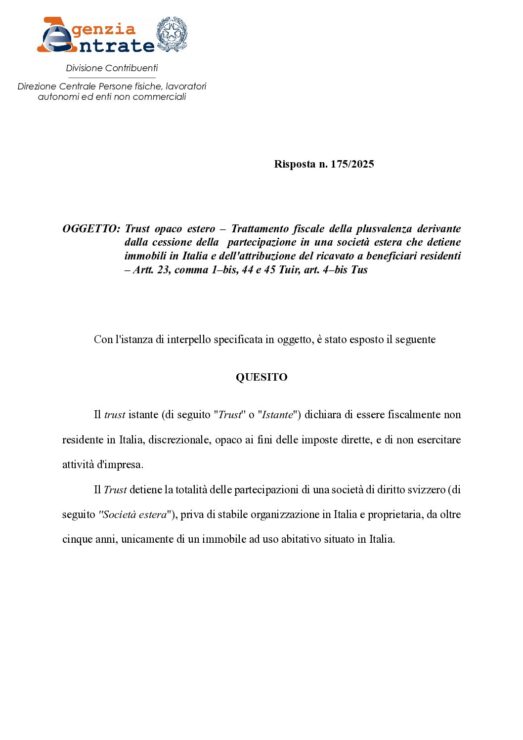
Italy’s Ruling No. 175 of July 4, 2025, confirms the scope and teeth of the new Article 23(1-bis) of the Italian Unified Statute on Direct Taxes (“TUIR”) “immovable-property-rich” look-through rule, introduced in the 2023 budget law. In a case involving a non-resident discretionary opaque trust selling shares of a Swiss company whose sole asset is an Italian residential property held for more than five years, the Italian Revenue Agency firmly rejected the taxpayer’s attempt to apply the five-year capital gain exemption for direct real estate sales to an indirect share disposal.
The decision aligns with OECD Model Article 13(4) and its policy aim: to preserve source-country taxing rights over gains from shares deriving their value principally from immovable property located there and the assessment of the Italian tax is permitted under the provisions of the US-Italy income tax treaty.
Facts and Questions Presented
The trust in question, resident outside Italy and operating as a discretionary, opaque vehicle with no business activity, held 100% of a Swiss company. For more than five years, the Swiss company’s only asset had been a single Italian residential property, not used in a trade or business and not classified as inventory. The trust planned to sell the Swiss shares to a third party and later considered distributing part or all of the proceeds to Italian-resident beneficiaries.
The taxpayer asked the Agency to rule on three points: (i) whether the gain from the sale would be Italian-source under Article 23(1-bis) TUIR; (ii) whether the five-year direct-sale exemption for Italian real estate under Article 67(1)(b) TUIR could apply by analogy; and (iii) how potential future distributions to Italian-resident beneficiaries would be taxed under Article 47-bis TUIR if the trust were in a privileged regime, including capital versus income allocation.
Taxpayer’s Position
The trust argued that Article 23(1-bis) TUIR should be interpreted in coordination with Article 67(1)(b) TUIR, which exempts gains from direct sales of Italian real estate held for more than five years. The exemption applies to gains derived from the sale real estate owned by individual taxpayers, outside of a trade or business, or by a foreign entity (a company or a trust) that owns the real estate as an investment property or rental property and does not operate a business for which the real estate can be considered to constitute an Italian permanent establishment of that entity.
The trust argued that Article 23(1-bis) TUIR should be interpreted in coordination with Article 67(1)(b) TUIR, which exempts gains from direct sales of Italian real estate held for more than five years. The exemption applies to gains derived from the sale real estate owned by individual taxpayers, outside of a trade or business, or by a foreign entity (a company or a trust) that owns the real estate as an investment property or rental property and does not operate a business for which the real estate can be considered to constitute an Italian permanent establishment of that entity.
The taxpayer argued that, in case the gain is considered taxable, the tax should be assessed on an amount equal to the difference between the sale price and the cost of the foreign entity’s shares to be sold.
Agency’s Analysis and Holding
The Revenue Agency disagreed with the position taken by the taxpayer on the taxability of the gain. Article 23(1-bis) of the TUIR, introduced in 2023, expressly subjects non-residents to Italian tax on gains from the sale of shares or similar interests in any entity – Italian or foreign – if, at any time in the 365 days preceding the sale, more than fifty percent of the entity’s value derives directly or indirectly from Italian immovable property. The only exceptions are for immovable property classified as inventory (“immobili merce”) or used in a business (“immobili strumentali”), where the gains enter into the computation of the taxpayer’s business income or loss for the year. No reference is made to the five-year exemption, which applies only to direct sales of the underlying real estate.
Consequently, the gain from the sale of the Swiss company’s shares was taxable in Italy as a other income (“reddito diverso”) of financial nature under Article 67(1)(c) and (c-bis) TUIR, calculated under Article 68(6) TUIR, and subject to the 26% substitute tax pursuant to Legislative Decree No. 461/1997.
Treaty Coordination: Italy–U.S.
Assuming the trust was resident in the United States (as it seems from the facts reported in the ruling) and met the limitations on benefits (LOB) clause of the US-Italy income tax treaty, the treaty would allow Italy to impose the tax on the gain from the sale of the shares of the Swiss company. Indeed, under Article 13(1) of the treaty, as modified by Protocol Article 1(12), shares deriving more than fifty percent of their value from Italian immovable property are treated as immovable property themselves. This allows Italy to tax the gain concurrently with the United States, while double tax relief is granted by the United States under Article 23.
Open Questions on Trust Distributions
The Agency declined to address how distributions from the trust to Italian-resident beneficiaries would be taxed. As a general rule, distributions from nonresident, fiscally opaque trusts are not taxable to an Italian resident beneficiary. However, a tax is imposed upon receipt of the distribution if the trust is organized in a tax privileged jurisdiction, and a foreign jurisdiction is considered tax privileged when the nominal rate of tax applicable on the trust’s income in that jurisdiction is less than fifty percent of the tax to which the trust would be labile if it were an Italian residents trust. The Italian reference nominal rate to apply the test is 24 percent. The test applies at the time the income is recognized by the trust under Italian income tax principles.
The taxpayer argued that, since the income is already taxed in Italy pursuant to article 23(10)-bis of TUIR, the distribution of the income to the Italian resident beneficiary should be exempt from tax.
These questions – potentially implicating Article 44, Article 45, and Article 47-bis of TUIR, as well as Article 4-bis of the Italian inheritance and gift tax code – were ruled inadmissible in the interpello procedure because they concerned different taxpayers other than the applicant and required factual details not provided in the submission.
Practical Implications
Ruling 175/2025 makes clear that the new look-through rule under Article 23(1-bis) of TUIR applies as designed, without importing exemptions intended for direct property sales. Taxpayers cannot rely on the five-year rule to shield indirect share sales from Italian taxation. For cross-border planners, treaty provisions – such as the Italy-U.S. Protocol equating certain shares with immovable property – should be reviewed carefully to understand concurrent taxing rights and foreign tax credit mechanics.
Where distributions to Italian beneficiaries are contemplated, a separate, fact-specific analysis will be needed to determine exposure under the anti-abuse rule of Article 47-bis and the capital/income split rules. Given the Agency’s refusal to address those questions here, practitioners should not assume that the treatment of the underlying gain will automatically carry over to the distribution stage.